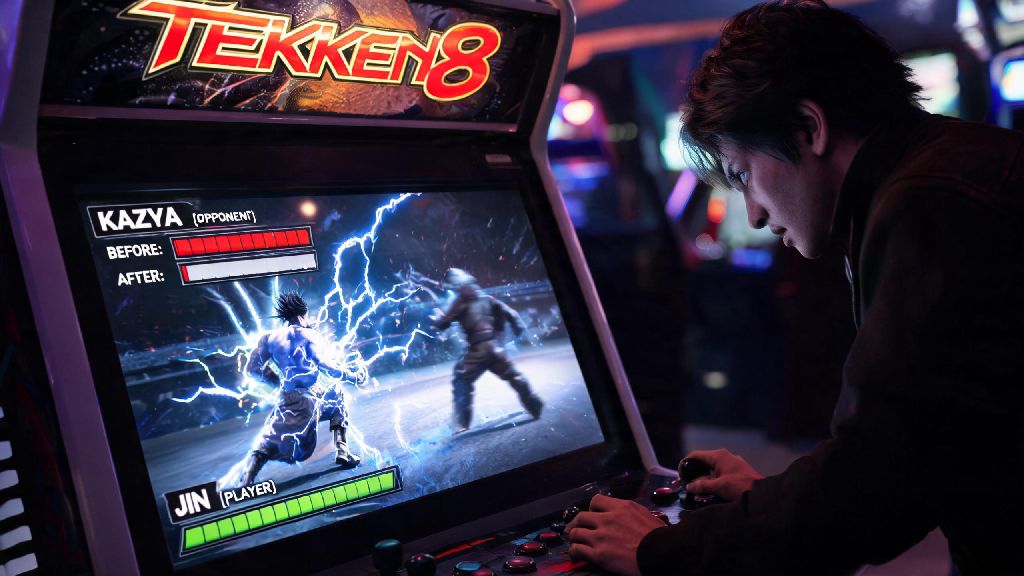
If you’ve ever watched a high-level Tekken 8 set and seen a player melt half their opponent’s health bar with a perfectly timed electric, you’ve probably wondered how to pull off the same feat yourself. Learning how to do electrics in Tekken 8 feels like unlocking a superpower at first, but it’s far more accessible than most new players assume, even if you’ve struggled with the input in earlier franchise entries. I’ve spent hundreds of hours in practice mode refining my own electric execution across Kazuya, Jin, and Devil Jin, and I’ve broken down everything you need to know to get consistent, no fancy arcade stick required if you prefer a standard console controller.
What You Need to Know Before Learning How to Do Electrics in Tekken 8
First, let’s clear up what an electric actually is, so you know exactly what you’re working toward. Electrics are the just-frame variant of the Mishima clan’s signature Wind God Fist move, available for Kazuya Mishima, Jin Kazama, Devil Jin, and Lars Alexandersson. The input for a regular Wind God Fist is forward, neutral, down, down-forward + right punch (often called 2 in Tekken notation), but an electric requires you to press the right punch button exactly on the frame you land on the down-forward input.
Electrics have a 12-frame startup compared to 15 frames for a regular Wind God Fist, which makes them fast enough to punish almost every unsafe move in the game. They also deal 10 more damage on average, give +5 frame advantage on block (compared to -1 for a regular WGF), and cause a longer stun on hit for easier combo follow-ups. That massive difference in utility is why electrics are non-negotiable if you want to play any Mishima character at a mid to high level.
You don’t need expensive gear to pull them off, either. I’ve seen top ranked players hit 10 electrics in a row on a $20 wired Xbox controller, so don’t let anyone tell you you need an arcade stick to be consistent. The only thing that matters is building correct muscle memory, not the hardware you use.
Step-by-Step Electric Execution for Both Controller and Stick Players
The core input is the same no matter what controller you use, but there are small tweaks you can make to fit your preferred playstyle. The most common mistake new players make is rushing the directional input, so take it slow when you first start practicing, instead of trying to hit the motion as fast as possible.
For controller players, I strongly recommend using the D-pad instead of the left analog stick. I tried using analog for my first month of practice and only hit 2 out of 10 electrics on average, and switching to D-pad pushed that number to 6 out of 10 overnight. But if you’re more comfortable with analog, you can still make it work — just turn off analog deadzone reduction in your controller settings to avoid accidental input skips.
Stick players will have an easier time with the neutral step, since the arcade stick naturally pops back to center when you let go of it. The only adjustment I recommend for stick players is to keep your grip loose, so you don’t accidentally hold the stick in a partial direction during the motion.
Before you start drilling, run through these quick checks to make sure you’re not setting yourself up for failure:
If you're using a controller, turn off analog stick input for movement in practice mode to avoid accidental misinputs that can throw off your timing. You can also turn on input display in practice mode to see exactly where your motion is going wrong, which cuts down your learning time by half.
Common Electric Mistakes and How to Fix Them Fast
Nearly every player runs into the same small set of mistakes when they first start practicing electrics, and most of them can be fixed with a tiny adjustment to your input. The first and most common issue is getting a regular Wind God Fist instead of an electric. That means you pressed the 2 button a frame or two too late, after you already landed on the down-forward input. The fix here is to slow down your entire motion by 20%, and focus on pressing 2 the exact second your thumb hits the down-forward position on the D-pad or stick.
The second most common mistake is getting a Dragon Uppercut instead of a Wind God Fist entirely. That happens when you press 2 while you’re still on the down input, before you roll to down-forward. If this keeps happening to you, try pausing for a split second once you hit down, before rolling to down-forward and pressing 2. I did this for the first week of my practice, and it completely eliminated my Dragon Uppercut misinputs.
The third most frequent issue is getting a random right punch or kick instead of any special move at all. That almost always means you skipped the neutral step between forward and down, so the game doesn’t register the full Wind God Fist motion. Fix this by practicing just the directional motion 20 times in a row without pressing any buttons, so you get used to letting the input return to center every time.
Don’t practice electrics in real matches for the first 10-15 hours of training — you’ll just build bad muscle memory from panicking, and you’ll end up frustrated when you miss every attempt. Stick to practice mode until you can hit 7 out of 10 electrics consistently when standing still, before you try using them in real games.
Drills to Build Consistent Electric Muscle Memory
You don’t need to spend 3 hours a day in practice mode to get good at electrics. Short, focused practice sessions are far more effective than long, unfocused ones, and you’ll see results much faster if you stick to a structured drill routine.
The first drill I recommend is the slow motion drill. Turn practice mode speed down to 50%, and try to hit 10 electrics in a row without any misinputs. Once you can hit 10/10 consistently, bump the speed up to 75%, and repeat the process until you hit 10/10 at full speed. This drill trains your muscle memory to get the input right, instead of relying on luck to hit the just-frame window.
Once you can hit electrics consistently when standing still, move on to the pressure drill. Set the practice dummy to jab you repeatedly, and practice blocking the jab then immediately doing an electric. This simulates the kind of pressure you’ll face in real matches, so you don’t freeze up when you have to execute the move while you’re focused on other things like blocking and spacing.
The final drill is the combo drill. Practice landing an electric then immediately following up with your go-to Mishima combo, because a raw electric is useless if you can’t capitalize on the stun to deal extra damage. I like to practice linking 2 electrics in a row for extra style points, but you can stick to simpler combos if you’re still new.
Even 10 minutes of focused electric practice every day will give you consistent results in less than two weeks, so don’t get discouraged if you only hit 2 or 3 out of 10 on your first day. I used to get so frustrated I’d throw my controller down after a bad practice session, but once I switched to short daily drills, I hit 8 out of 10 electrics consistently after just 10 days.
Pulling off electrics consistently is one of the most satisfying milestones you can hit as a Tekken 8 player, and it opens up entirely new combo and pressure options for every Mishima main. Once you master how to do electrics in Tekken 8, you’ll notice you can hold your own against much higher-ranked players, since the move’s speed and damage make it one of the most versatile tools in the entire game. Don’t get discouraged if you miss more than you hit at first — every top player spent hours in practice mode refining their input, and the payoff is more than worth the time you put in.